Iran's Removal from Trade Corridors Due to Alignment with China and Russia Against Israel and the US
Introduction: Iran's Strategic Role in the Regional Economic Geography
In a world that is rapidly reshaping business and logistics patterns, Iran's geographical position as a natural bridge between Asia, Europe, and the Middle East has always been presented as a strategic opportunity for economic development. However, the images presented depict a concerning reality: Iran is being removed from emerging trade corridors. this removal is not due to internal incapability, but rather the result of China and Russia's active alignment with Israel and America in creating and developing alternative routes that bypass Iran. This article comprehensively examines this phenomenon, its causes, key related projects, and its implications for Iran's national security and economy.
Why is Iran's removal from trade corridors happening due to the alignment of China and Russia with Israel and America and...?
The good news is that we have a solution!
Get the solution at the end of the article
Part One: A Chart of Strategic Elimination – Analysis of the "Geoeconomic Isolation of Iran" Chart
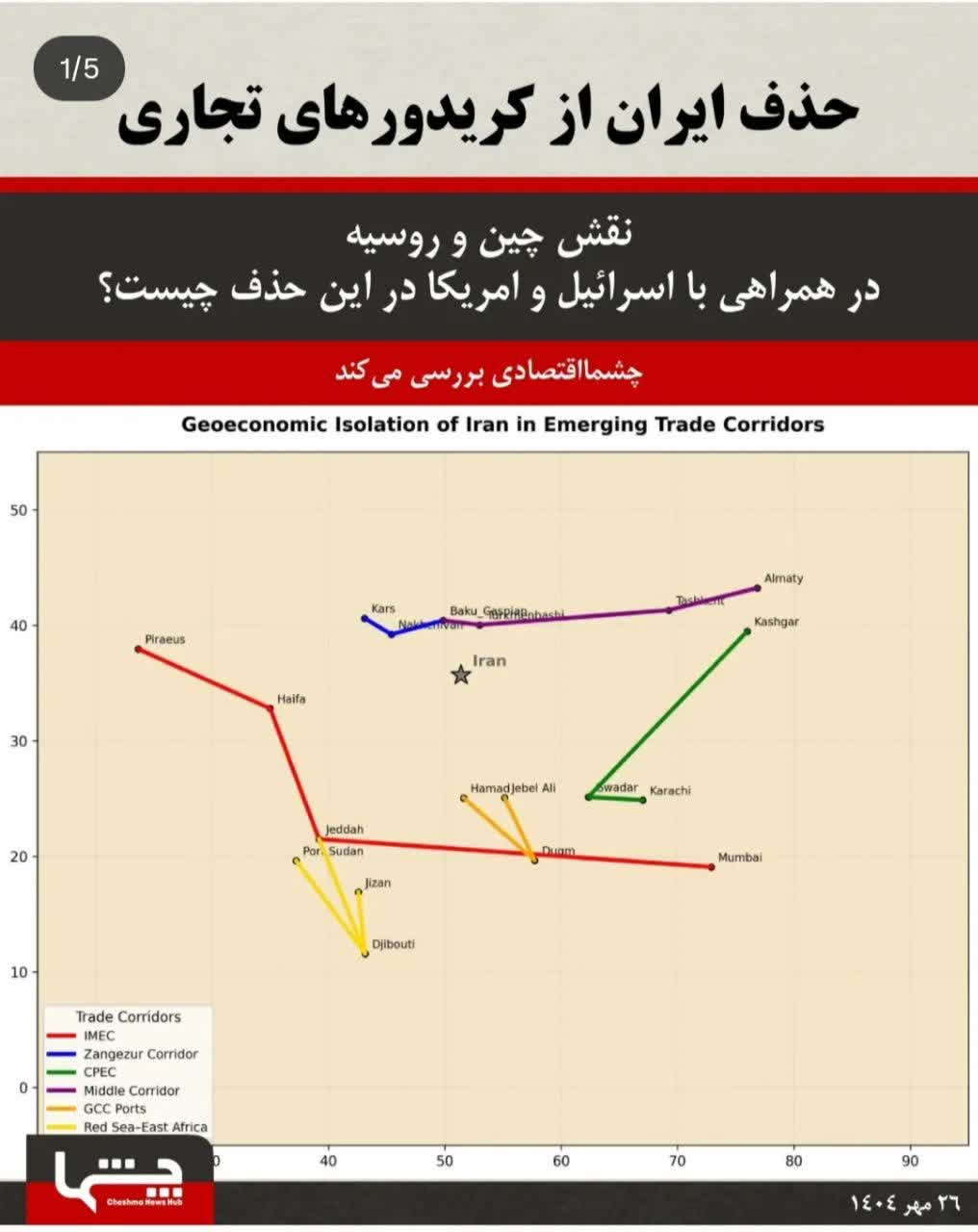
The chart presented in the first image, titled "Geoeconomic Isolation of Iran in Emerging Trade Corridors," provides a powerful visual representation of Iran's current situation. This "network map" type chart shows key cities and trade corridors, marking Iran with a star. Notably, none of the major corridor lines pass through Iran. In contrast, numerous routes include:
- IMEC (India-Middle East-Europe Corridor): Passing through ports in India (Mumbai), the Persian Gulf (Dubai, Jebel Ali), and Israel (Haifa, Piraeus).
- CPEC (China-Pakistan Economic Corridor): Starting from Gwadar, Pakistan, and connecting to Karachi and Kashmir.
- Zangezur Corridor: Passing through southeastern Armenia and western Azerbaijan.
- Middle Corridor: Passing through the Caucasus and Central Asia (Baku, Tbilisi, Tashkent).
This chart clearly shows that Iran is an isolated point within these new networks. This "geoeconomic isolation" is not a coincidence, but the result of a policy strategy in which China and Russia, in cooperation with Israel and America, have designed routes that bypass and exclude Iran from the regional economic flow.
src="/media/mehrdad-startup-1-r57-238x300.png"Part Two: Key Projects that Exclude Iran
Next, we examine the strategic projects that have directly or indirectly led to Iran's exclusion from trade corridors.
src="/media/mehrdad-startup-1-77-ب-238x300.png"1. India-Middle East-Europe Corridor (IMEC)
This corridor, introduced at the September 2023 G20 summit as an India-Israel-Saudi-Europe corridor, aims to create a completely alternative route to Iran's North-South Corridor. This route, passing through European Mediterranean ports (Piraeus) and Israeli ports (Haifa), and Indian ports (Mumbai), bypasses Iran and is implemented with the cooperation of countries such as Israel, the UAE, Saudi Arabia, India, Italy, the USA, and the European Union. This corridor is not just a trade route, but a political tool for creating a new "economic axis" that excludes Iran.
src="/media/mehrdad-startup-1-5-218x300.png"2. Saudi Arabia-China-Gulf Cooperation Agreement
In China's heavy investment in new ports in Jizan, Sudan, and Djibouti, the goal is to transfer energy from the Persian Gulf to East Africa and the Mediterranean without needing Iran. These projects, known as the "Red Sea and East Africa," have been sidelined from the Chinese port chain due to sanctions and regional tensions. This action has dealt a direct blow to Iran's strategic position in controlling the Strait of Hormuz and the Sea of Oman.
3. The "Turkey-Azerbaijan-Nakhchivan" Project (Zangezur Corridor)
This project, which has been operationally implemented, provides a completely alternative route for Azerbaijan to connect with the Nakhchivan Republic (which is landlocked by Iran). This corridor, implemented through Armenia with the support of Turkey and Azerbaijan, bypasses Iran, meaning Iran's exclusion from this transit route. This project also serves as a political tool to weaken Iran in the Caucasus region.
src="/media/mehrdad-startup-1-ل-200x300.png"4. Expansion of Russia's Transit Routes through Central Asia
Russia, by creating new transit routes through Kazakhstan-Turkmenistan and the Caspian Sea to India and China, has removed Iran from its transit routes. These routes, created due to banking and insurance sanctions against Iran, do not pass through Iran's Bandar Abbas and Gwadar ports, instead using Russian and Kazakh ports.
5. The Role of the UAE, Qatar, and Oman in Maritime Transit
The Arab countries of the southern Persian Gulf, with heavy investment in Jebel Ali and Hamad ports, are seeking to create a new logistics hub that bypasses Iran. By supporting alternative routes and competing with Iranian ports, these countries play a key role in excluding Iran from trade corridors.
src="/media/mehrdad-startup-1-4-240x300.png"6. China's Strategic Shift (Reducing Dependence on the Iranian Route)
China, predicting that Iran will not be able to play a key role in transit routes for the next few years, has moved towards alternative routes like CPEC and BRI. This strategic shift, made considering regional security and economic developments, has led to a reduction in China's dependence on Iran and an increased dependence on Pakistan and Kazakhstan.
src="/media/mehrdad-startup-1-33-195x300.png"7. The Collapse of Iran's Role in the Regional Energy and Fuel Supply Market
Despite its rich oil and gas reserves, Iran has been sidelined from its key role in the regional energy market due to oil sanctions and an inability to supply regional fuel. This situation, resulting from international sanctions and Iran's inability to provide logistics and transit services, has diminished Iran's importance in the regional oil and gas markets.
8. Internal Crisis and Banking and Insurance Sanctions
No global trade route is willing to pass through a country under banking, insurance, and SWIFT sanctions. This internal crisis, stemming from international sanctions and Iran's inability to provide logistics and transit services, has led to Iran's exclusion from global trade corridors.
9. Increased Israeli Presence in the Persian Gulf and Red Sea
Israel, with Emirati and Bahraini cooperation, is establishing a direct presence in the Persian Gulf and Red Sea. This presence, carried out with the support of the US and the EU, has created a "blind spot" area around Iran. This area, extending from the coastline, means Iran's exclusion from regional trade corridors.
10. Changes in Global Insurance and Shipping Routes after the Gaza War
Large insurance and shipping companies, due to insecurity in the Hormuz and Bab-el-Mandeb regions, have chosen alternative routes through East Africa and the Mediterranean. This route change, which is due to regional tensions and increased insurance costs, has led to a decrease in shipping volume in Iran.
Part Three: Iran's Military and Strategic Response
In the fourth image, a photo of Commander of the Army Navy, Shahram Noveisi, is presented. In this image, he at a conference, with reference to his speech, said that unprecedentedly few military officials had clarified to this extent: "The entire effort and strategy of the enemy is to limit the corridors so that only they can benefit from them and somehow eliminate us." This statement is an explicit admission by Iranian military officials of the reality of Iran's elimination from trade corridors.
He continues: "In the same speech, he warned that Iran's development documents should be written based on strategic regenerative foundations, while developments are oblivious to the changes in new regional realities. His emphasis was that if our perspective remains from 'shore to sea' and not vice versa, Iran will gradually be erased from the role of global trade."
This statement shows that Iranian military officials have realized the reality of Iran's elimination from trade corridors and are formulating new strategies to deal with this situation. However, these strategies, which are based on Iranian "geopolitical changes," have not yet been implemented operationally and require a profound change in Iran's economic and security policymaking.
Part Four: Conclusion and Iran's Future in Trade Corridors
Finally, the fifth image provides a key summary of Iran's situation in trade corridors. This summary, which begins with "If we want to summarize," shows that Iran has been mapped out for elimination in the 1400s. This elimination has occurred in four main axes:
- East (Turkey-Europe): By creating the Zangezur corridor.
- West (Turkey-Europe): By creating the IMEC corridor.
- North (Caucasus): By creating the CPEC corridor.
- South (China-Pakistan): By creating the CPEC corridor.
This elimination is not a coincidence, but the result of a policy strategy in which China and Russia, with the cooperation of Israel and America, have designed routes that bypass Iran and exclude it from the regional economic flow. This situation has not only been an economic blow but also a strategic blow to Iran's national security.
Finally, this article concludes that Iran, to prevent complete elimination from trade corridors, needs a profound change in economic and security policymaking. This change must include internal reforms, reduction of sanctions, creation of regional cooperation, and strengthening of Iran's strategic position in the region. Otherwise, Iran will remain in the coming decades as a landlocked and economically isolated country.