Mehrdad { mehrdad }: History and Meaning of the Name Mehrdad
Here we want to talk about the name Mehrdad and the history of this name
src="/media/Coin_of_Mithradates_I_of_Parthia_Seleucia_mint.jpg"Silver coin of Mithridates IThe name Mehrdad is a very old Persian name that was also chosen for several kings during the Parthian period in Iran. The name Mehr is a very common name, and there is also a month named Mehr in Iran.
Other names that start with Mehr include the following names
Mehrshad- Mehran- Mehrab- Mehrad- Mehraneh- Mehrzad- Mehri- Mehrsa- Radmehr- Mehrazad- Shadmehr- Mehroush- Bozorgmehr- Mehrta- Zadmehr- Mehrdokht- Mehravrid- Mehrush- Mehrigan and others…
Persian Wikipedia
Mehrdad is one of the Iranian names for men. This name is one of the original Persian names that was used for the kings of Iran during the Arsacid period.
Mehrdad is derived from Middle Persian Mihrdat, meaning "given by Mehr." Mehr in turn is derived from Avestan Mithra, the Zoroastrian divinity of covenant. In modern Iran, the name Mehrdad is also used to refer to several historical figures known in Western literature as Mithridates, the Hellenized form of Mehrdad. This name consists of two parts: Mehr meaning sun and Dad meaning creator (creator of the sun); and it was the name of two of the greatest kings of Iran and the Arsacids. (Pronunciation: mehr dād) Gift of Mehr, created by Mehr; (in history) the name of three Arsacid kings was Mehrdad (Arsacid kings 6, 9, 13); Mehrdad was also the name of one of Astyages' appointees who Cyrus was entrusted to; and also the name of Khosrow Parviz's son. Also, in some old books, it has been used as the word for prophet.
The meaning of the name Mehrdad
Gift of the Sun
Origin of the name Mehrdad
Persian name
Dehkhoda's dictionary mentions the following for Mehrdad
Mehrdad I
Mehrdad I. [m d a v] (Akh) Arsacid VI. The sixth king of the Arsacid dynasty. He brought the Arsacid empire to its peak of power and defeated and captured Demetrius, the king of the Seleucids. He was the first king of the Arsacids to call himself King of Kings and reigned from 173 to 140 BC.
Mehrdad II
Mehrdad II. [m d du] (Akh) Arsacid IX. Titled the Great. The ninth king of the Arsacid dynasty and one of the most famous, who reigned from 124 to 76 BC. He defeated the Scythians, established trade relations with China, and in 92 BC made a friendship treaty with the Roman state and conquered Mesopotamia around 90 BC.
Mehrdad III
Mehrdad III. [m d s v] (Akh) Arsacid XII. The twelfth Arsacid king (56-55 BC). He killed his father, Phraates III, and went to extremes in cruelty and ruthlessness until they rebelled against him and brought his brother Orodes to the throne. See History of Iran by Mirza Mohammad Khan Qajar, p. 151.
Mehrdad IV
Mehrdad IV. [m d ch r] (Akh) King of Parthia, titled Philopator Philadelphus. He apparently reigned from 170 to 150 BC, during the period between the death of Phraates II and the end of the reign of Balash II in Iran, but no documents or writings from his time exist.
Mehrdad V
Mehrdad V. [m d p j] (Akh) King of Parthia, titled Euergetes, who apparently reigned from 150 to 121 BC and made peace with the Romans during his reign.
Mehrdad VI
Mehrdad VI. [m d sh sh] (Akh) Son of Mehrdad V and titled Eupator, known as the Great. He was born around 132 BC and reigned from 120 to 63 BC. There is no precise information about his youth and the beginning of his reign. Gradually, he gained control over Cappadocia, Paphlagonia, Bithynia, and all the southern and eastern parts of the Black Sea. His opposition to the kings of Bithynia led to his enmity with the Roman state, which caused Mehrdad to fight the Romans three times, and these wars are known in history as the Mithridatic Wars. In the first Mithridatic War, which lasted from 88 to 84 BC, Mehrdad initially achieved some victories until his general in Greece was defeated by the Roman general Sulla, and Mehrdad was forced to make peace and pay a large indemnity. The second Mithridatic War lasted from 83 to 81 BC. In this war, Mehrdad defeated the Roman army and attacked Pontus. In the third war (74-64 BC), Mehrdad occupied Bithynia and recaptured Pontus (68-67 BC). But he was defeated by the Roman general Pompey in 66 BC and fled to Crimea, where he eventually committed suicide. Mehrdad VI was one of the greatest commanders in history and the greatest enemy of Rome in all ages. See History of Iran by Mirza Mohammad Khan Qajar, pp. 147-149.
Laodice
Laodice. [u] (Akh) Daughter of Mehrdad II, king of Pontus, whom Antiochus III (the Great) married after making an alliance with Mehrdad. (221 BC) (Ancient Iran, vol. 3, p. 2080)
Mithridatium
Dehkhoda's Persian Dictionary
(m r) [ma'r.] (A.) an antidote elixir, the preparation of which is first attributed to Mithridates, king of Pontus from the Parthian dynasty; mithridatium.
Wikipedia says the following about Mehrdad
Mehrdad I (in Pahlavi: Mihrdāt), Arsacid V in the new count, known as Mehrdad the Great[1], was the King of Kings of Iran from 171 BC to 132 BC and the main architect of the Arsacid Empire. His conquests transformed the Arsacid state from a small kingdom into a world empire and one of the greatest powers of his time.[2] He was the first Arsacid king to adopt the title of the Achaemenid kings, King of Kings.
Name
Mehrdad means "given by Mehr." This name comes from the Old Persian Miθradāta. Its Pahlavi (Parthian) form was Mihrdāt, and the Greeks and Romans called it Mithridates.
The Old Persian form is Mithradāta, while in Modern Persian it is Mehrdad (Mehrdad).
Family and Accession
Mehrdad was the son of Friapati and the grandson of Arsaces I. He had several brothers, the eldest of whom, Phraates I, had ascended the throne in 176 BC after their father.
According to ancient custom, the king should choose one of his sons as his successor, but although the children of Phraates had priority over Mehrdad I in the line of succession, he broke the custom and chose his brother as his successor because of the abilities he had shown.[1][3]
Reign
After the death of Phraates I, Mehrdad ascended the throne in his place. In his first major military operation, he turned toward the Greco-Bactrian Kingdom. The Greco-Bactrian Kingdom, which had been weakened by long wars with Sogdia and Indian states, was hardly defeated by the Arsacid king, and Mehrdad entered Bactria and annexed the region to his empire.[1]
After that, Mithridates turned his attention to the Seleucids. In 146 BCE, he attacked Media and captured Hamadan.[4] Following this, in 141 BCE, he entered Babylon and Mesopotamia, where he was officially crowned as King of Kings of Iran.[5] Coins from this period, minted in the city of Seleucia, have survived. After that, he went to Gorgan to defend the northern borders of the Parthian Empire. At the same time, Parthian generals conquered Persia and Elam in his name.
src="/media/Conquest_of_Mithridates_I.svg_-1024x531.png"Map of Mithridates I's rule Mithridates I's conquests
While the city of One Hundred Gates was chosen as the first capital of the Parthian Empire, Mithridates I also established royal residences in Seleucia, Ecbatana, Ctesiphon, and his newly founded city of Mithradatkert. Additionally, Mithradatkert was the location where a tomb was built for and maintained the Parthian kings.[6] On the other hand, Ecbatana became the summer residence of the Parthian royal family.[7] The city of Ctesiphon was not chosen as the capital until the reign of Gotarzes I,[8] but according to Brosius, it was used as a location for coronations and was a symbolic city of the Parthian rule.[9]
In 140 BCE, the Seleucids again attacked Mesopotamia. While Mithridates was busy fighting the Scythians in the east,[11] Demetrius II Seleucus conquered Mesopotamia. However, the Seleucids were soon defeated and driven out in the same year. Even Demetrius himself fell into the hands of the Parthians and was sent to Gorgan to Mithridates. He received the Seleucid king warmly and even gave his daughter, Rhodogune, in marriage to him.[12] Mithridates then punished the king of Elam for helping the Seleucids.[13][11] The Parthian King of Kings also allowed Vardfradad II, the frataraka of Persis, to have more autonomy in his domain. Mithridates died in 132 BCE and Phraates II succeeded him.
Coins and Imperial Ideology
From the early years of the second century BCE, the Parthians placed greater emphasis on their claim to be the successors of the Achaemenid Kings of Kings. They claimed that Arsaces, the first Parthian king, was a descendant of Artaxerxes II, the Achaemenid King of Kings.[14] The royal titles of the Achaemenids were also revived during the Parthian period, the most important of which was the title "King of Kings" (Shahanshah). Mithridates I was the first Parthian ruler to mint coins with this title, however, it took until the time of Mithridates II for this title to become the usual title of Parthian kings.[14][11] Also, the early Parthian kings depicted themselves on their coins wearing the Median tiara.[14]
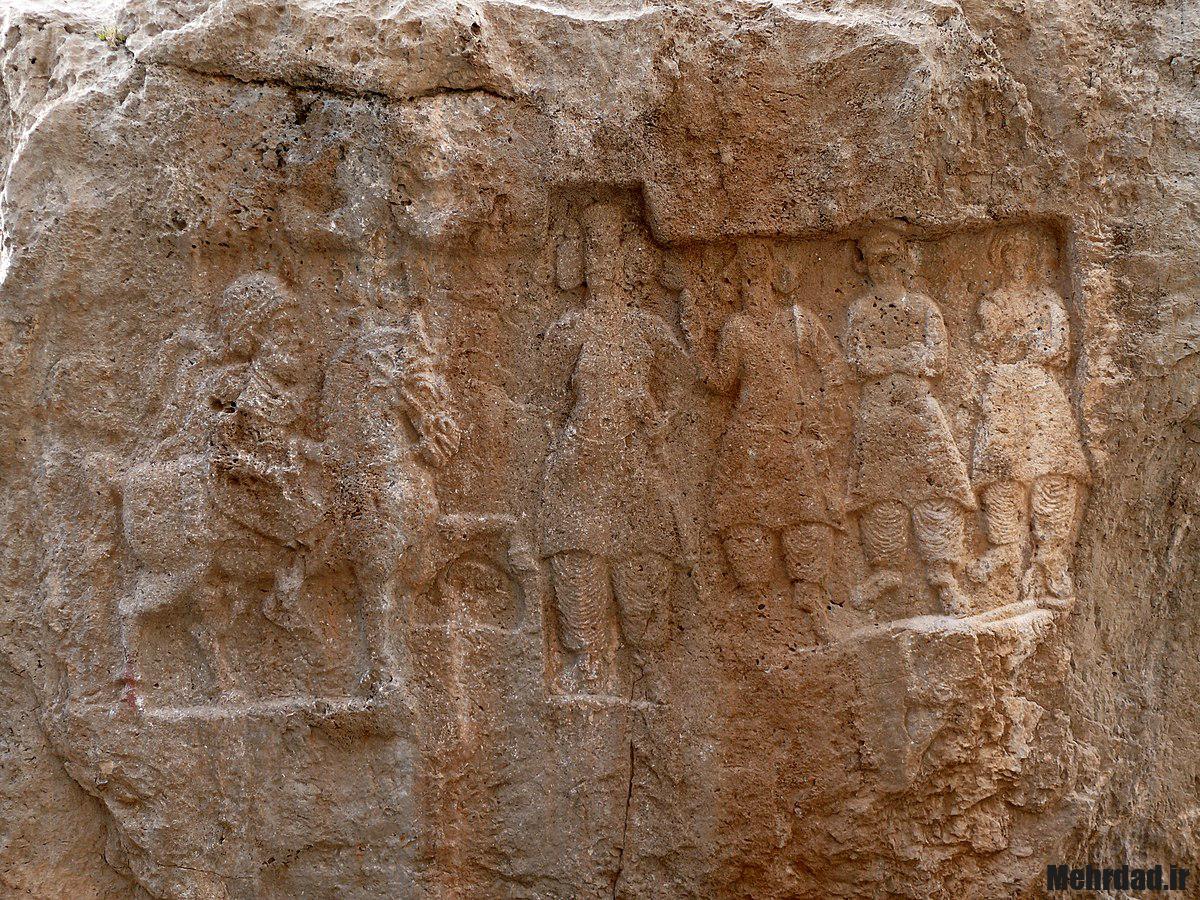
src="/media/1200px-Xong-e_Ashdar_Parthian_relief-1024x768.jpg"Parthian Mithridates relief Parthian Mithridates relief in KhuzestanThe earliest coins of Mithridates I also show him wearing the Median tiara. However, as the power of this King of Kings grew, he was depicted on his newer coins with a royal diadem.[15][16] He also adopted some Hellenistic traditions, but unlike Greek rulers and early Parthians, he was depicted on his coins as a bearded man, which was a sign of his claim to be the successor of the ancient Iranian Kings of Kings.[16]
Mithridates I also had the title Philhellene (Friend of the Greeks) inscribed on his coins after conquering Mesopotamia to establish friendly relations with the Greeks whose lands he had recently conquered.[17] Another title he inscribed on his coins was "Arsaces" which later changed to "Arsaces King" and eventually became "Great King Arsaces".[16] Arsaces, the name of the first Parthian king, was the official name of all Parthian Kings of Kings until the fall of this dynasty.[1][18]
"Whose father is a god" was another title of Mithridates I. Phraates II, his successor, also had this title inscribed on his coins.[16]
Legacy
The most important achievement of Mithridates during his lifetime was transforming the Parthian kingdom from a local ruling power into a world empire.[11] He pursued this goal through his conquests in the west, aiming to reach the Mediterranean by dominating Syria and establishing Iranian hegemony over that region. However, this goal became a major conflict between Iran and Rome that lasted until the end of the Sassanian period and did not reach any definitive conclusion.[11] As Mithridates is considered the main architect of the Parthian Empire, some place him alongside Kings of Kings such as Cyrus the Great, the founder of the Achaemenid Empire